
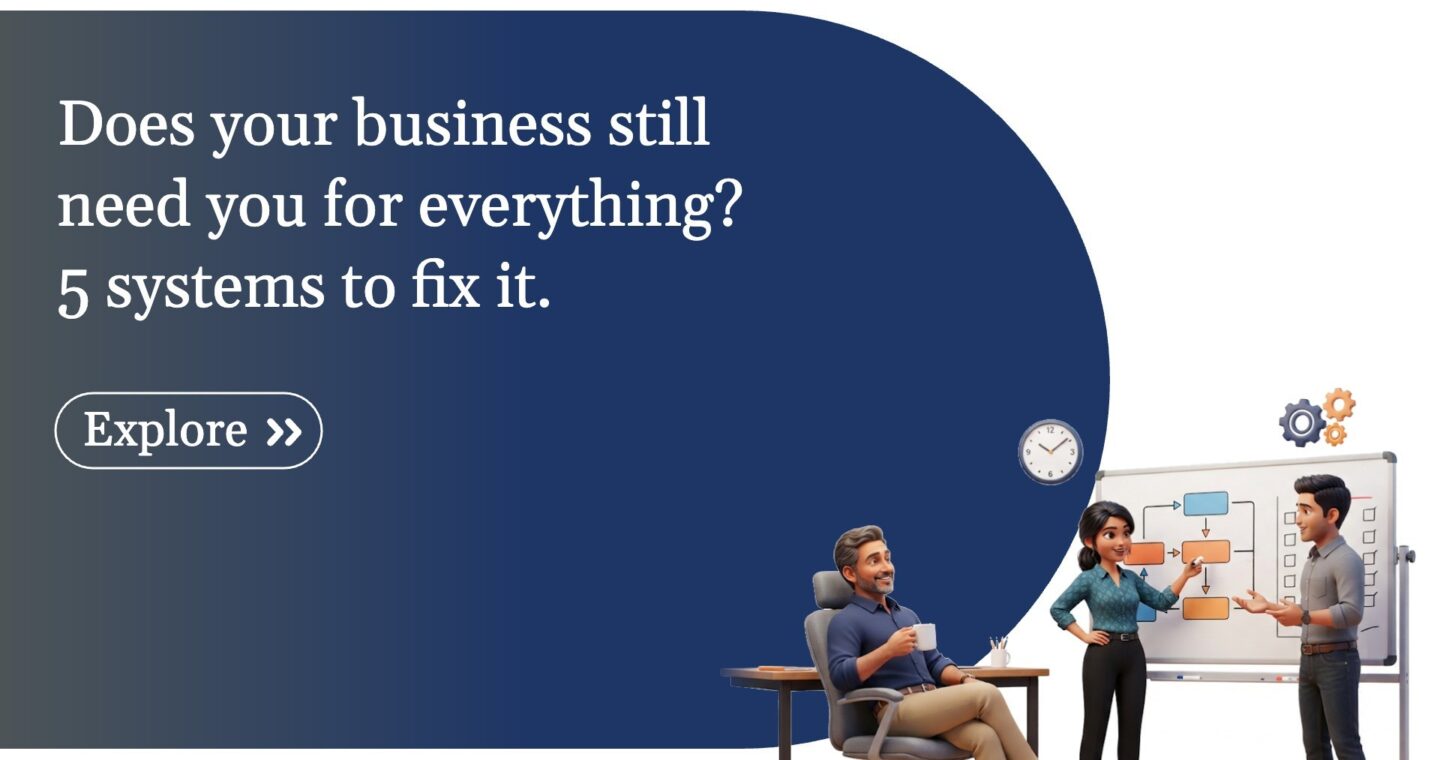
Does your business still need you for everything? 5 systems that give you your time back
Here’s a test. Imagine you switch off your phone for one full week. No calls, no WhatsApp, no “just one quick thing”.
What stops?
For many owners of growing businesses, the honest answer is: quite a lot. Orders wait for approval. Salary waits for you to check the sheet. Nobody knows the GST login. A new joinee sits around because “sir will explain”.
That isn’t a sign of bad people. It’s a sign of missing systems. And it quietly limits how big your business can grow, because everything has to pass through one person’s day.
Why this matters more than it looks
A February 2026 analysis in HRKatha pointed out that the average MSME worker produces only about 14% of the output of a worker in a large enterprise. There are many reasons for that gap, including skills, technology and capital. But anyone who has worked inside small companies has seen one simple reason again and again: people waiting. Waiting for approvals, waiting for information, waiting for the owner.
Systems don’t replace your judgment. They make sure your judgment is only needed for things that actually need you.
Here are five systems we set up first.
1. Approval limits: who can say yes to what
Write down, on one page, who can approve what, and up to how much.
- Purchases up to ₹25,000: department head. Above that: owner.
- Leave up to 3 days: reporting manager. Longer: HR or owner.
- Discounts up to 5%: sales head. Beyond that: owner.
The numbers will be different for you. The point is that they exist, and everyone knows them. You’ll be surprised how many “urgent” calls disappear in the first month.
2. An access list for every login
GST portal, bank, PF, ESIC, website, social media, the accounting software. In many businesses only the owner has all of these, often on one phone.
Make a secure access list: which logins exist, who uses each one, and who is the backup. Use a password manager or a sealed, controlled document, not a WhatsApp message. Change passwords when someone leaves.
This is as much about risk as about time. If one person is unavailable, the business shouldn’t stop.
3. A second-in-command for each area
Pick one person per area (sales, accounts, operations, HR) who can take decisions when you are not around. Then tell the whole team, clearly, in writing.
Start small: let them handle one week while you are still around and reachable. Review what they decided, not to correct them in public, but to agree on what “good” looks like. Trust grows with practice, not with speeches.
4. One-page SOPs for things that repeat
Anything that happens every week or every month deserves a one-page SOP: how a new order is processed, how salary is prepared, how a customer complaint is handled, how a new employee is inducted.
Keep each SOP short:
- what triggers the process,
- the steps, in order,
- who does each step,
- what “done” looks like.
The test of a good SOP: a reasonably smart new person can follow it without calling you.
5. A monthly people calendar
Salary on a fixed date. PF and ESIC payments on time. Attendance closed by a fixed day. Appraisal check-ins every quarter. Compliance registers updated.
Put all of this on one calendar, with a name against every item. If “everyone” owns it, nobody does.
This is also where software earns its keep. When attendance, leave, payroll and employee records live in one HRMS like HR Bingo, much of the monthly people calendar runs on its own, and you look at a dashboard instead of five spreadsheets.
Where to start on Monday
Don’t try to fix all five at once. Pick the one that interrupts you most often this week. For most owners it’s approvals or salary.
Write one page. Share it with the team. Follow it for a month. Then pick the next one.
Within a quarter, you’ll notice something: the business still needs you, but for the things only you can do, like customers, strategy and growth.
We’re talking about exactly this on our new podcast, Systems with Shreya, made for business owners who are tired of being the answer to every question in the office.
Which of these five would free up the most of your time? DM us or connect with us to know more. We help growing businesses build simple people systems that run without the owner in every decision.
This article is general guidance for business owners, not legal or professional advice. Please adapt it to your business, industry and location.
Sources: HRKatha, “MSME workers deliver just 14% of large-firm output” (25 Feb 2026); Huminivex client experience.
Want help putting this into practice in your business?
Book a free consultation